
Utilizzando questo sito acconsenti all'utilizzo di cookie. I cookie possono essere gestiti per mezzo del tuo browser o attraverso le impostazioni del dispositivo.
PROGETTO INIZIATIVE TURISTICHE DEL COMUNE DI LIVORNO 2026
ALTARE INGHIRAMI - ALTAR INGHIRAMI - ALTAR INGHIRAMI - AUTEL INGHIRAMI - ALTAR INGHIRAMI - OLTÁR INGHIRAMI
ALTARE INGHIRAMI
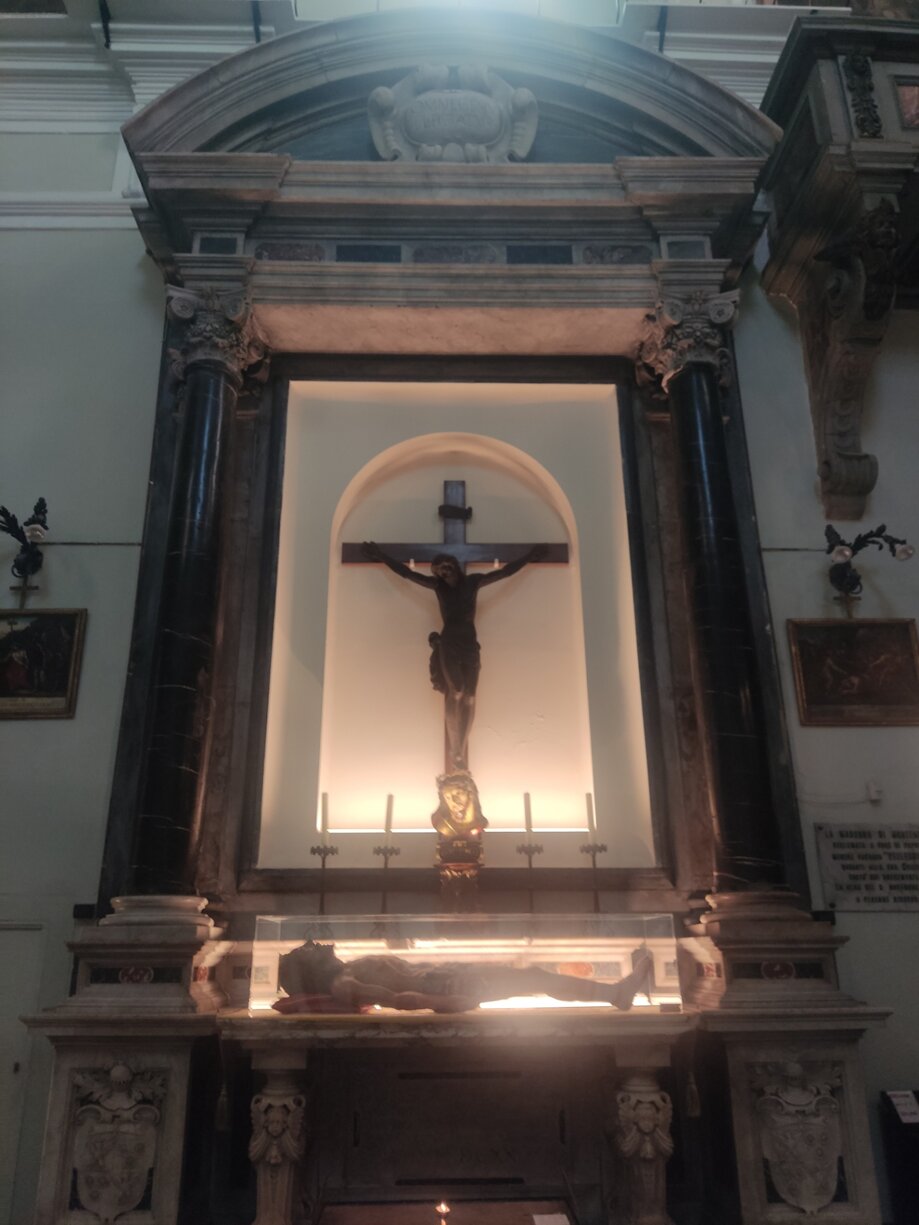
Quest’altare non fu fatto costruire da nessuna Nazione, ma da un illustre personaggio: il Cavaliere di Santo Stefano e capitano della Marina di Toscana Tommaso Fedra Inghirami di Volterra nel 1629. La struttura e formata dall’altare in marmo bianco, i pilastri in marmo nero venato di bianco, c’è un particolare, le “paraste” sono di “breccia” che è una roccia sedimentaria. Sotto la mensa c’è l’epigrafe con questa iscrizione latina; “ARAM HAC THOMAS PHEDRA INGHIRAMIUS VOLTERRANEUS / AEQUES D. STEPHANI AC DUX TRIREMIS LEGAVIT – IULIUS ET CURTIUS FRATRES EREXERE A.D. MDCXXIX”, vi è descritto che fu un volere dello stesso Cavaliere a far erigere questo altare commissionando il lavoro ai fratelli Giulio e Curzio. Nelle basi delle colonne vediamo lo stemma di suddetta famiglia che costa in un’aquila e tre ruote disposte in cerchio. Su una cartella posta in alto al centro del frontone leggiamo questa frase: “OMNE GENU FLECTATUR” (Ogni ginocchio si pieghi); essa era il tema della pala d’altare che vi si trovava rappresentante il “Nome di Gesù adorato nei cieli, sulla terra e sotto terra”. L’autore fu Baldassarre Franceschini detto il Volterrano. Oggi al suo posto ammiriamo un bel Crocifisso di legno scuro, pregevole opera d’arte, commissionato dal commerciate genovese Carlo Cambiaghi nel 1630, donato alla Compagnia delle Stimmatine di san Francesco e poi recuperato dalle macerie della seconda guerra mondiale, restaurato da Cesare Tarrini, e donato a questa chiesa dove tutt’ora è venerato.
ALTAR INGHIRAMI
This altar was built by a famous character: Knight of St. Stephen of Tuscany and captain of the Navy Tommaso Fedra Inghirami of Volterra in 1629. The structure is formed from the altar of white marble, the pillars of black marble veined with white, the "parastades" are made of "breccia" which is a sedimentary rock. Under the altar is the epigraph to this Latin inscription, "ARAM THOMAS PHEDRA INGHIRAMIUS VOLTERRANEUS HAC / AEQUES D. STEPHAN AC DUX TRIREMIS LEGAVIT - IIULIUS ET CURTIUS FRATRES EREXERE AD MDCXXIX ", so it was a wish of the Knight who built this altar and he commissioned the work to the brothers Julius and Curzio. On the bases of the columns is the crest of this family: an eagle and three wheels arranged in a circle. On a folder placed in the top center of the pediment we read this sentence: "OMNE GENU FLECTATUR" (Every knee should bow), it was the subject of the altarpiece depicting the "Name of Jesus worshiped in heaven and on earth and under the earth ". The author was Baldassare Franceschini said Volterrano. In its place today we admire a beautiful crucifix of dark wood, fine art work, commissioned by Carlo Cambiaghi in 1630, donated to the Compagnia delle Stimmatine di san. Francesco and then recovered from the rubble of World War II, restored by Cesare Tarrini, and donated to this church where it still is revered.
ALTAR INGHIRAMI
Este altar no fue construido por una nación , sino de un personaje distinguido : el Caballero de San Esteban y capitán de la Toscana Marina di Tommaso Fedra Inghirami de Volterra en 1629 . La estructura está formada por el altar en mármol blanco , las columnas de mármol negro con vetas blancas , hay un particular, " pilastras " son " avance" , que es una roca sedimentaria. Bajo el altar con esta inscripción no es la inscripción latina " ARAM HAC THOMAS PHEDRA INGHIRAMIUS VOLTERRANEUS / AEQUES D. STEPHANI AC DUX TRIREMIS LEGAVIT - Iulius ET CURTIUS FRATRES EREXERE AD MDCXXIX " , describe que era un deseo del caballero que construyó este altar encargó la obra a los hermanos Julius y Curzio . Las bases de las columnas que vemos el escudo de la familia por encima de lo que cuesta un águila tres ruedas dispuestas en círculo. En una carpeta que se encuentra en la parte superior central del frontón se lee esta frase: " Omne GENU FLECTATUR " ( doble toda rodilla ) , que fue el tema del retablo que fue representante del "Nombre de Jesús adorado en el cielo y en la tierra y en los abismos " . El autor se dijo Baldassare Franceschini Volterrano . En su lugar hoy admirar un hermoso crucifijo de madera oscura, trabajo de arte , encargado por los genoveses negociado Cambiaghi Carlo en 1630 , donó a la Sociedad de los Estigmas de San Francisco y luego se recuperó de entre los escombros de la Segunda Guerra Mundial, restaurado por César Tarrini , y donado a esta iglesia , donde aún es venerado .
AUTEL INGHIRAMI
Cet autel n’a pas été fait construire par une Nation mais par un illustre personnage : le Chevalier de Saint Etienne et capitaine de la Marine de Toscane Thomas Fedra Inghirami de Volterra en 1629. La structure est formée par l’autel en marbre blanc, les piliers en marbre noir aux veinures blanches. Un détail : les parastades sont en brèche, une roche sédimentaire. Sous la table il est écrit en latin : « HARAM HAC THOMAS PHEDRA INGHIRAMIUS VOLTERRANEUS / AEQUES D. STEPHANI AC DUX TRIREMIS LEGAVIT – IULIUS ET CURTIUS FRATRES EREXERE A.D. MDCXXIX », où il est décrit que cet autel a été construit grâce au Chevalier qui confia les travaux à ses frères Giulio et Curzio. Sur les bases des colonnes on voit les armoiries de cette famille : un aigle et trois roues disposées en cercle. Sur un panneau disposé en haut au centre du fronton on lit la phrase « OMNE GENU FLECTATUR » (que chaque genou fléchisse) qui était le thème du retable qui représentait « le Nom de Jésus adoré dans les cieux, sur la terre et sous la terre ». L’auteur fut Baldassare Franceschini dit le Volterrano. Aujourd’hui à sa place nous admirons un beau Crucifix en bois foncé, œuvre d’art précieuse, commandée par le commerçant génois Carlo Cambiaghi en 1630, offert à la Compagnie des Stigmatines de Saint François e par la suite récupéré dans les décombres de la deuxième guerre mondiale, restauré par Cesare Tarrini, et offert à cette église où il est encore vénéré.
ALTAR INGHIRAMI
Dieser Altar wurde von keiner Nation gebaut, aber aus einer angesehenen Persönlichkeit : der Ritter von St. Stephen und Kapitän der Toskana Marina di Tommaso Fedra Inghirami von Volterra im Jahre 1629 . Die Struktur vom Altar aus weißem Marmor gebildet wird, die Säulen aus schwarzem Marmor mit weißen Adern , gibt es eine besondere " Pilaster " sind " Durchbruch" , die ein Sedimentgestein ist . Unter dem Altar mit dieser Inschrift befindet sich die lateinische Inschrift " ARAM HAC THOMAS PHEDRA INGHIRAMIUS VOLTERRANEUS / AEQUES D. STEPHANI AC DUX TRIREMIS LEGAVIT - Iulius ET CURTIUS Fratres EREXERE AD MDCXXIX " , beschreibt , dass es ein Wunsch der Ritter, dieser Altar in Auftrag gegeben , die Arbeit der Brüder Julius und Curzio gebaut war . Die Basen der Säulen sehen wir das Familienwappen über dem kostet ein Adler drei Rädern in einem Kreis angeordnet. Auf einem Ordner in der oberen Mitte des Giebels lesen wir diesen Satz finden: " Omne GENU FLECTATUR " ( Jedes Knie beugen sollen ) , es war das Thema des Altars , die Vertreter der "Name des Jesus im Himmel und auf angebetet war Erden und unter der Erde. " Der Autor wurde Baldassare Franceschini sagte Volterrano . An seiner Stelle heute bewundern ein schönes Holzkreuz dunkel, feinen Kunstwerk , von den Genuesen gehandelt Cambiaghi Carlo im Jahre 1630 , gespendet, um die Gesellschaft der Stigmata des heiligen Franziskus und dann aus den Trümmern des Zweiten Weltkriegs erholt, restauriert von Caesar Tarrini beauftragt , und zu dieser Kirche, wo er immer noch verehrt wird gespendet.
OLTÁR INGHIRAMI
Tento oltár nebol postavený žiadnym národom, ale význačnou osobnosťou: Rytierom Rádu Svätého Štefana a kapitánom Námorníctva Toskánska Tommasom Ferda Inghirami z Volterry v roku 1629. Konštrukcia je tvorená z oltára z bieleho mramoru, pilierov z čierneho mramoru s bielymi žilami, zvláštnosťou sú pilastry, ktoré sú vyrobené zo štrku, čo je usadená hornina. Pod oltárom je tento latinský nápis: „ARAM HAC THOMAS PHEDRA INGHIRAMUS VOLTERRANEUS / AEQUES D. STEPHANI AC DUX TRIREMIS LEGAVIT – IULIUS ET FRATRES EREXERE A.D. MDCXXIX!, je na ňom napísané, že oltár bol postavený z vôle rytiera, ktorý zadal túto stavbu bratom Július a Curzio. Na základoch stĺpov vidíme erb tejto rodiny, na ktorom stojí orol a tri kolesá, usporiadané v kruhu. Na priečinku umiestnenom v hornej časti štítu čítame túto vetu: „OMNE GENU FLECTATUR“ (Nech sa ohne každé koleno); to bolo predmetom oltárneho obrazu, ktorý bol tu predstavuje „Meno Ježiša uctievaného v nebi,i na zemi i pod zemou“ . Autorom bol Baldassarre Franceschini prezývaný tiež Volterrano. Na jeho mieste dnes obdivujeme krásny tmavý drevený kríž, cenné umelecké dielo, ktoré zadal obchodník z Janova Carlo Cambiaghi v roku 1630, ktorý bol darovaný Spoločenstvu Stigmata svätého Františka a potom obnovený z trosiek druhej svetovej vojny, zrekonštruovaný Cesarom Tarrini a venovaný tomuto kostolu, kde je doteraz uctievaný.