
Utilizzando questo sito acconsenti all'utilizzo di cookie. I cookie possono essere gestiti per mezzo del tuo browser o attraverso le impostazioni del dispositivo.
PROGETTO INIZIATIVE TURISTICHE DEL COMUNE DI LIVORNO 2026
ALTARE CORSO -ALTAR CORSO -ALTAR CORSO -
AUTEL CORSE - ALTAR KURS - KORZICKÝ OLTÁR
ALTARE CORSO
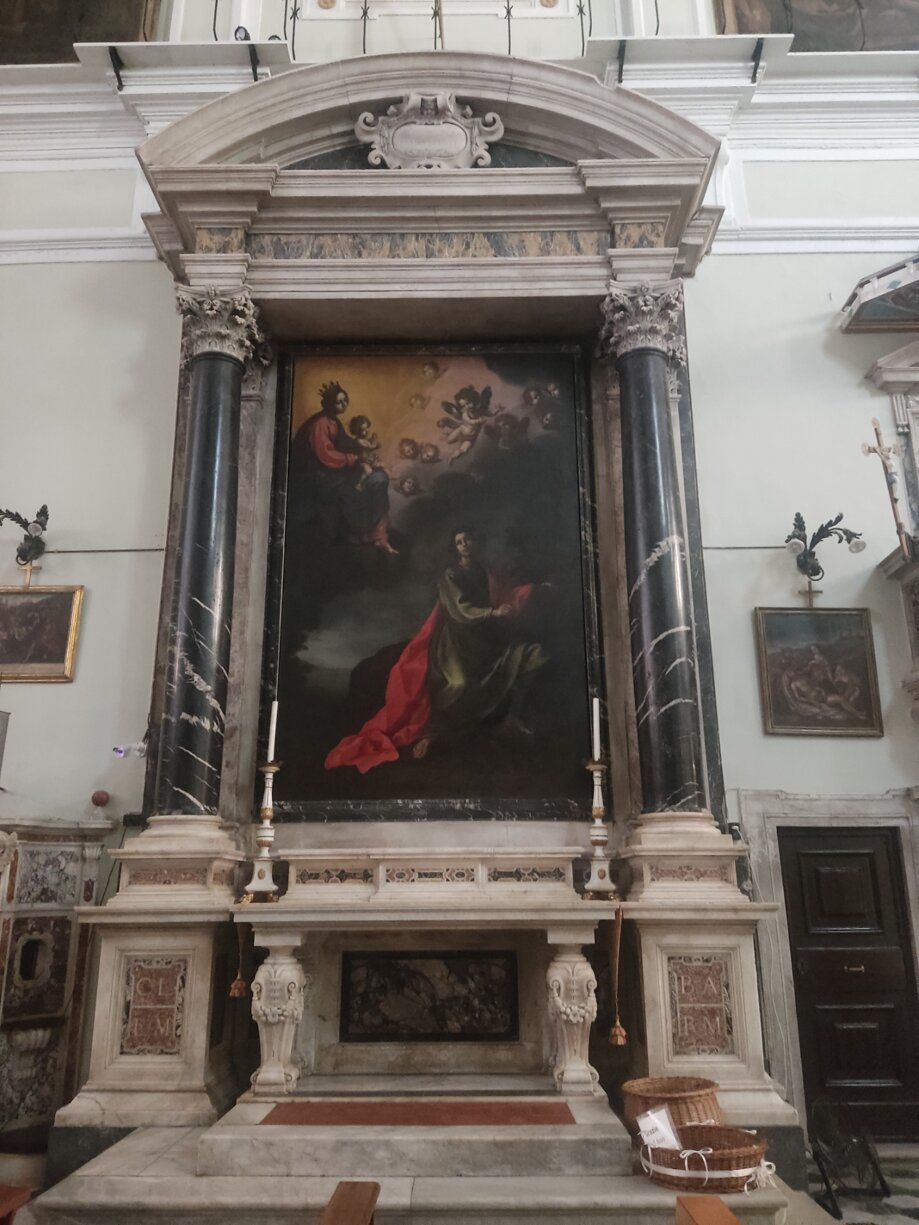
Altare dedicato all’“Apparizione della Vergine e San Giovanni Evangelista”. La pala d’altare fu dipinta da Francesco Curradi (1579 – 1661) di scuola barocca fiorentina. La tela rappresenta San Giovanni Evangelista con dinanzi il libro del Vangelo e col volto giovanile rivolto verso l’alto a contemplare la Vergine che porta sulle ginocchia il Bambino Gesù benedicente, tra le nuvole spuntano le teste ricciolose dei putti. I lavori di quest’altare iniziarono nel 1620, anno in cui quattro Corsi si presentarono ai Frati Minori chiedendo di poter avere un altare per le loro funzioni religiose. Si noti l’altare in marmo bianco, i pilastri in marmo nero venato di bianco, c’è un particolare, le “paraste” sono di “breccia” che è una roccia sedimentaria. Vi sono dei fregi con elementi in rosso armonico. All’interno del frontone, in alto, vi è una cartella in marmo bianco con un’iscrizione latina: “VIRGINEM VIRGINI COMMENDAVIT” (Affido il Vergine alla Vergine) rifacendosi al cap. 19, 26-27 del Vangelo di Giovanni. Le basi delle colonne sono in marmo calcareo fossilifero lavorato ad intarsio; nella base sinistra notiamo incise le iniziali di Carlo Lorenzi e Lucio Mattei, mentre a destra si leggono le iniziali di Battista Angeli e Rocco Manfredini, erano i quattro personaggi che chiesero la costruzione di quest’opera. Quest’altare fu dedicato dai Corsi a San Giovanni Evangelista perché nella loro patria era molto sentita questa devozione.
ALTAR CORSO
Altar dedicated to '"Apparition of the Virgin and St. Giovanni Evangelista." The altarpiece was painted by Francesco Curradi (1579 - 1661), belonging to the school Florentine baroque. The painting depicts St. Giovanni Evangelista with the book of the Gospel. His youthful face is facing up to contemplate the Virgin carrying the Child Jesus blessing on her knees, curly-headed cherubs emerge from the clouds. The works of this altar began in 1620 when four Corsi asked the Friars Minor in order to have an altar for their religious services. Altar of white marble and pillars of _ black marble veined with white are worthy of note, the "pilasters" are made of "breccia" (sedimentary rock). There are friezes with harmonious elements in red. Within the pediment there is a tablet in white marble with a Latin inscription: "VIRGINIA VIRGINEM COMMENDAVIT" (I entrust the virgin to the Virgin ) referring to the cap. 19, 26-27 of the Gospel of Giovanni The bases of the columns are made of marble inlaid fossiliferous limestone; we see in the left base engraved with the initials of Carlo Lorenzi and Lucio Mattei, while on the right you read the initial Battista Angeli and Rocco Manfredini: four people who asked this opera. This altar was dedicated to St. Giovanni Evangelista because this devotion was deeply felt in Corsica.
ALTAR CORSO
Altar dedicado a la " Aparición de la Virgen y San Juan Evangelista. " El retablo fue pintado por Francesco Curradi (1579 - 1661) la escuela barroca de Florencia. La pintura representa a San Juan Evangelista con antes que el libro del Evangelio y con el rostro juvenil hacia arriba para contemplar a la Virgen que lleva al Niño Jesús la bendición de rodillas, meter la cabeza en las nubes ricciolose putti . El trabajo de este altar se inició en 1620, año en el que se presentan cuatro clases de los Frailes Menores piden tener un altar para sus servicios religiosos . Tenga en cuenta el altar de mármol blanco, las columnas de mármol negro con vetas blancas , hay un particular, " pilastras " son " avance" , que es una roca sedimentaria. Hay algunas decoraciones con elementos rojos armoniosas. En el frontón en la parte superior , hay una carpeta en mármol blanco con una inscripción en latín : " VIRGINEM Virgini COMMENDAVIT " ( Virgen encomiendo a la Virgen ) que se refiere a la tapa . 19 , 26 a 27 del Evangelio de Juan. Las bases de las columnas son de caliza fosilífera incrustaciones de mármol , tomamos nota dejada en la base grabada con las iniciales de Charles Lorenzi y Lucio Mattei , mientras que a la derecha de leer las iniciales del Bautista y ángeles Rocco Manfredini , era a las cuatro personas que solicitaron la construcción de este trabajo . Este altar fue dedicado a San Juan Evangelista en Corsi porque su tierra era mucho sentido esta devoción .
AUTEL CORSE
Autel dédié à « l’Apparition de la Vierge à Saint Jean Evangéliste ». Le retable fut peint par Francesco Curradi (1579-1661) d’école baroque florentine. La toile représente Saint Jean Evangéliste, l’Evangile posé devant et au visage juvénile tourné vers le haut à contempler la Vierge qui porte sur ses genoux l’Enfant Jésus bénisseur ; entre les nuages surgissent les têtes bouclées des putti. Les travaux de cet autel commencèrent en 1620, année où quatre corses se présentèrent aux Frères Mineurs en demandant de pouvoir obtenir un autel pour leurs fonctions religieuses. A’ noter l’autel en marbre blanc, les piliers en marbre noir aux veinures blanches. Un détail : les parastades sont en brèche, roche sédimentaire. On y trouve des décorations avec des éléments en rouge harmonieux. A’ l’intérieur du fronton, en haut, il ya un panneau en marbre blanc où il est inscrit en latin « VIRGINEM VIRGINI COMMENDAVIT » (je confie le Vierge à la Vierge) en se rapportant au ch. 19, 26-27 de l’Evangile de Jean. Les bases des colonnes sont en marbre calcaire fossilifère en marqueterie; sur la base gauche on note les initiales gravées de Carlo Lorenzi et Lucio Mattei, alors qu’à droite on lit les initiales de Battista Angeli et Rocco Manfredini : ce sont les quatre personnages qui demandèrent la construction de cette œuvre. Cet autel fut dédié par les Corses à Saint Jean Evangéliste car cette dévotion était très ressentie dans leur patrie.
ALTAR KURS
Altar zu " gewidmet " Erscheinung der Jungfrau Maria und St. Johannes der Evangelist . " Barock Schule von Florenz - Das Altarbild wurde von Francesco Curradi (1661 1579) gemalt. Das Gemälde zeigt Johannes der Evangelist mit vor dem Buch des Evangeliums und mit dem jugendlichen Gesicht nach oben, um die Jungfrau trägt das Jesuskind auf seinen Knien Segen betrachten , ihre Köpfe in den Wolken ricciolose Putten . Die Arbeit dieser Altar begann im Jahre 1620 , dem Jahr , in dem vier Klassen werden den Minoriten bitten, einen Altar für ihre Gottesdienste haben vorgestellt. Notieren Sie sich den Altar aus weißem Marmor , die Säulen aus schwarzem Marmor mit weißen Adern , gibt es eine besondere " Pilaster " sind " Durchbruch" , die ein Sedimentgestein ist . Es gibt einige Dekorationen mit roten Elementen harmonisch. Innerhalb der Giebel an der Spitze gibt es einen Ordner, in weißem Marmor mit einer lateinischen Inschrift : " VIRGINEM VIRGINI COMMENDAVIT " (Virgin vertraue ich der Jungfrau ) , die sich auf der Kappe . 19 , 26-27 des Johannes-Evangeliums . Die Basen der Säulen sind fossiliferous Kalkstein Marmor Intarsien , stellen wir fest, links in der Basis mit den Initialen von Charles Lorenzi und Lucio Mattei eingraviert , während auf der rechten Seite die Initialen des Täufer und Engel Rocco Manfredini lesen , waren die vier Personen, die für den Bau gefragt diese Arbeit . Dieser Altar wurde St. Johannes der Evangelist in Corsi gewidmet , weil ihre Heimat war sehr viel gefühlt Hingabe.
KORZICKÝ OLTÁR
Oltár je zasvätený „Zjaveniu Panny Márie Stätému Jánovi Evangelistovi“. Oltár je dielom Francesco Curradi (1579 – 1661) ) z barokovej florentskej školy. Obraz zachytáva Stätého Jána Evangelistu s knihou Evanjelium a s mladistvou tvárou vzhliadajúcou nahor v rozjímaní o Panne, majúcej na kolenách žehnajúce Dieťa Ježiša, medzi oblakmi vykúkajú kučeravé hlavy anjelov. Práce na tomto oltári začali v roku 1620, v roku, v ktorom sa štyria Korzičania dostavili k Menším Bratom, so žiadosťou, aby im bol poskytnutý oltár pre ich náboženské funkcie. Oltár je z bieleho mramoru, stĺpce sú z čierneho mramoru pretkaného bielymi žilami, je tu jedna zvláštnosť, pilastry sú vyrobené zo štrku, čo je usadená hornina. Sú prítomné vlysy z harmonicky zladených červených prvkov. V štíte, uloženom hore, je tabuľa z bieleho mramoru s latinským nápisom: „VIRGINEM VIRGINI COMMENDAVIT“ (Zverila Panne panna) s odkazom na cap. 19, 26-27 z Evanjelia Jána. Základy stĺpov sú mramorového fosílneho vápenca vypracovaného v intarziách; v ľavej časti základne možno vidieť vyryté iniciály Battista Angeli a Rocco Manfredini, to boli štyria ľudia, ktorí požiadali o výstavbu tohto diela. Tento oltár bola venovaný Korzičanmi Stätému Jánovi Evangelistovi, pretože v ich vlasti bola silne cítit oddanosť k nemu.