
Utilizzando questo sito acconsenti all'utilizzo di cookie. I cookie possono essere gestiti per mezzo del tuo browser o attraverso le impostazioni del dispositivo.
PROGETTO INIZIATIVE TURISTICHE DEL COMUNE DI LIVORNO 2026
PORTE APERTE ALLA CHIESA DELLE NAZIONI
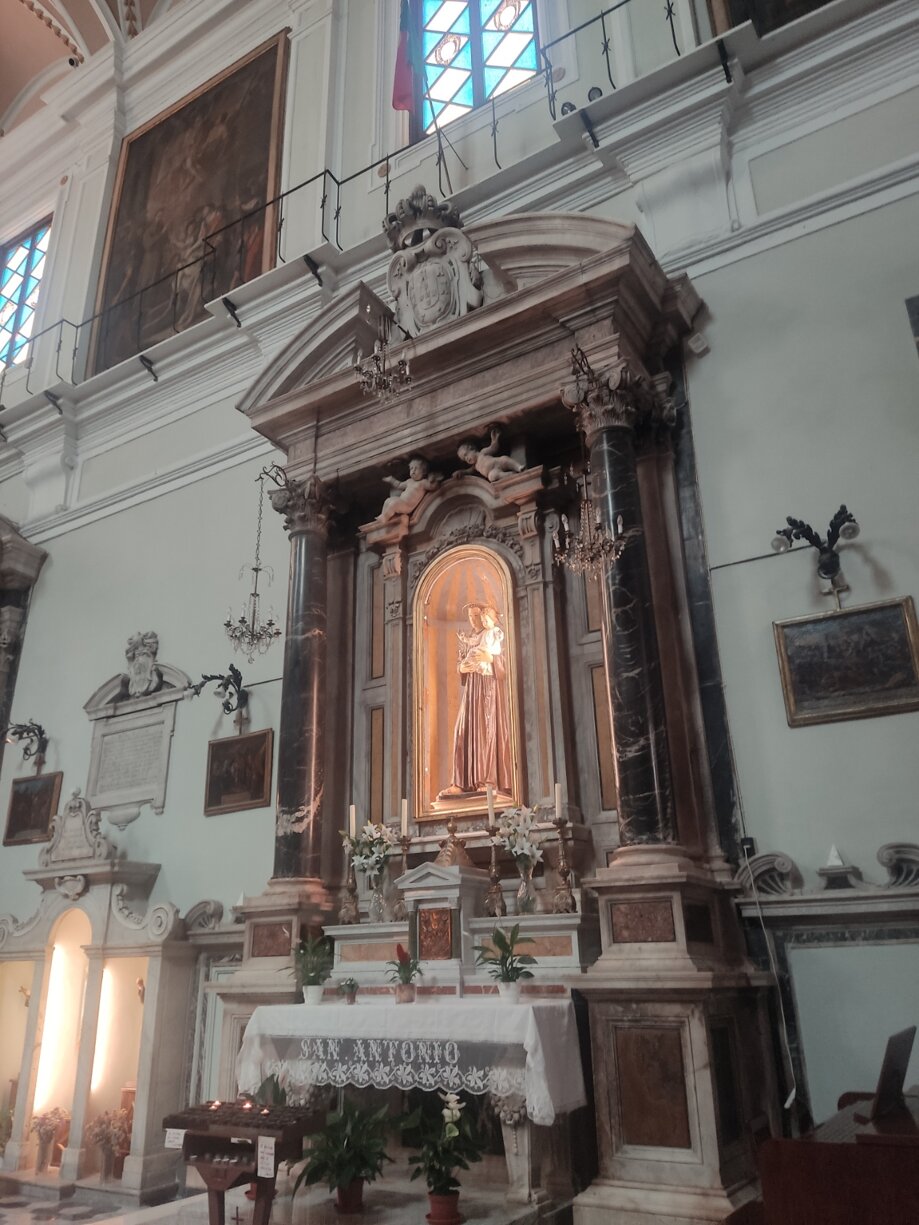
ALTARE OLANDESE-ALEMANNO
Quest’altare fu dedicato a Sant’Andrea Apostolo, fatto costruire dai popoli Fiamminghi e
Alemanni; tra loro costituirono una Congregazione, la quale sosteneva i propri connazionali che
erano o ammalati o carcerati. La scelta di eleggere Sant’Andrea come loro patrono fu fatta
attraverso una votazione ed i cattolici, che erano in maggioranza, elessero questo protettore. Il 6
giugno del 1622 fu stipulato un contratto tra il rappresentante viennese Giorgio Wierts ed i Frati
Minori con il quale i Fiamminghi ottenevano in questa chiesa un luogo per poter costruire un
proprio altare, subito ebbero inizio i lavori di costruzione. La pala d’altare, rappresentante il
“Martirio di Sant’Andrea Apostolo”, fu dipinta dal pittore fiammingo Giovanni Bilivert (1576 –
1644) su ispirazione dei racconti degli Atti del martirio di Sant’Andrea avvenuto in Grecia.
Possiamo mirare nel dipinto il Santo con il volto sereno rivolto verso la croce decussata ed a braccia
aperte aspettando il martirio. Tutt’intorno vi sono diverse figure in attesa del tragico evento. In alto
uno squarcio di luce, circondato da un festoso girotondo di putti, indica la gloria divina, attesa
dall’Apostolo martire. Si noti l’altare in marmo bianco, i pilastri in marmo nero venato di bianco,
c’è un particolare, le “paraste” sono di “breccia” che è una roccia sedimentaria.
ALTAR-DUTCH ALEMANNO
This altar was dedicated to Sant'Andrea Apostolo built by the Germans and the Flemish people, the
congregation maintained their fellow countrymen who were sick or in prison. The decision to
appoint St. Andrea as their patron was made through a vote and the Catholics, who were in the
majority, chose this protector. On 6 June 1622 a contract was made between the representative
Viennese Wierts George and the Friars Minor, with which the Flemings obtained in this church a
place to build their own altar. Soon began the construction works. The altarpiece, representing the
"Martyrdom of Sant'Andrea Apostolo," was painted by the Flemish painter John Bilivert (1576 -
1644). He was inspired by the stories of the Acts of the martyrdom of St. Andrea in Greece. We can
see the Saint with the serene face turned towards the cross, arms outstretched waiting for
martyrdom. All around there are several figures waiting for the tragic event. Top beam of light,
surrounded by a festive round of putti, shows the divine glory, waiting by the Apostle Martyr. Note
the altar of white marble, the pillars of black marble veined with white, the "parastades" are made
of "breccia" which is a sedimentary rock.
ALTAR DE HOLANDÉS- ALEMANNO
Este altar fue dedicado a San Andrés Apóstol , construida por el pueblo flamencos y alemanes ,
entre los que se formó una congregación , que demandó a sus compatriotas que estaban enfermos o
en prisión. La decisión de elegir como su patrón San Andrés se hizo a través de un voto , y los
católicos , que eran la mayoría, se eligió este protector . El 6 de junio de 1622 se hizo un contrato
entre el representante de Viena Giorgio Wierts y los hermanos menores con los que los flamencos
obtenidos en esta iglesia un lugar para construir su propio altar , se iniciaron de inmediato las obras
de construcción . El retablo , que representa el " Martirio de San Andrés Apóstol , " fue pintado por
el pintor flamenco Giovanni Bilivert (1576 - 1644) con la inspiración de las historias de las Actas
del martirio de San Andrés ha pasado en Grecia. Nuestro objetivo en la pintura con el rostro sereno
Santo se volvió hacia la cruz dibujada y los brazos abiertos esperando el martirio. A su alrededor
hay varios personajes que esperan el trágico suceso . Arriba un rayo de luz , rodeada por un círculo
de festivo putti, indica la gloria divina , a la espera por el apóstol mártir . Tenga en cuenta el altar de
mármol blanco, las columnas de mármol negro con vetas blancas , hay un particular, " pilastras "
son " avance" , que es una roca sedimentaria.
AUTEL HOLLANDAIS-ALLEMAND
Cet autel fut dédié à Saint André Apôtre. Il a été fait construire par les peuples Flamands et
Allemands. Ils constituèrent entre eux une Congrégation qui soutenait ses propres compatriotes
malades ou prisonniers. Le choix d’élire Saint André comme leur patron fut fait à travers un vote et
les catholiques, qui étaient majoritaire, élurent ce protecteur. Le 6 juin 1622 fut stipulé un contrat
entre le représentant viennois G. Wierts et les Frères Mineurs avec lesquels les Flamands obtinrent
dans cette église un lieu pour pouvoir construire leur propre autel. Les travaux de construction
commencèrent de suite. Le retable, représentant le «Martyre de Saint André Apôtre» fut peint par
l’artiste flamand Giovanni Bilivert (1576-1644) inspiré par les récits des Actes du martyre de Saint
André qui s’était produit en Grèce. Dans la peinture nous pouvons observer le Saint au visage
serein tourné vers la croix décussée et aux bras ouverts attendant le martyre. Tout autour différentes
figures attendent le tragique événement. En haut, un lambeau de lumière entouré par une ronde
joyeuse de putti indique la gloire divine attendue par l’apôtre martyr. A’ noter l’autel en marbre
blanc e les piliers en marbre noir aux veinures blanches. Un détail: les parastades sont en brèche,
une roche sédimentaire.
ALTAR HOLLÄNDISCHES - ALEMANNO
Dieser Altar wurde nach St. Andrew der Apostel gewidmet , gebaut von den Menschen Flamen und
Deutschen, unter ihnen bildeten eine Gemeinde , die ihre Landsleute, die entweder krank oder im
Gefängnis waren behauptet . Die Entscheidung, als ihren Schutzpatron St. Andreas Wahl wurde
durch eine Abstimmung gemacht, und die Katholiken, die in der Mehrheit waren , wählten sie
diesen Schutz . Am 6. Juni 1622 wurde ein Vertrag zwischen dem Wiener Vertreter Giorgio Wierts
und den Minoriten , mit denen die Flamen in dieser Kirche ein Ort, um ihre eigenen Altar bauen
erhalten , begann sofort mit den Bauarbeiten gemacht . Mit Inspiration aus den Erzählungen der
Apostelgeschichte des Martyriums des St. Andrew in Griechenland passiert ist - Das Altarbild , als
Vertreter der " Martyrium von St. Andrew der Apostel , " wurde von der flämischen Malers
Giovanni Bilivert (1644 1576) gemalt. Wir wollen in der Malerei mit dem Heiligen heitere Gesicht
zum Kreuz gezeichnet und offenen Armen wartet Martyrium geworden. Rundherum gibt es
mehrere Figuren warten auf die tragische Ereignis . Top einen Einblick in Licht , das durch einen
Kreis von festlichen Putten umgeben , zeigt die göttliche Herrlichkeit , wartet der Apostel Märtyrer
. Notieren Sie sich den Altar aus weißem Marmor , die Säulen aus schwarzem Marmor mit weißen
Adern , gibt es eine besondere " Pilaster " sind " Durchbruch" , die ein Sedimentgestein ist .
HOLANDSKÝ OLTÁR
Tento oltár, zasvätený Svätému Ondrejovi Apoštolovi, bol postavený flámskymi a holandskými
národmi; ktorí spoločne založili Zbor, ktorý podporoval ich krajanov, ktorí boli chorí alebo vo
väzení. Rozhodnutie o vymenovaní Svätého Ondreja ako ich patróna bol vykonaný hlasovaním
a katolíci, ktorí boli vo väčšine, zvolil tohto ochrancu. Dňa 6. júna 1622 bola uzavretá zmluva
medzi viedenským predstaviteľom Georgeom Wiersom a rádom Menších Bratov, s ktorou Flámi
získali v tomto kostole miesto na stavbu oltára, okamžite začali stavebné práce. Oltárny obraz
znázorňujúci "Mučenícku smrť Svätého Ondreja Apoštola," namaľoval Flemingský maliar
Giovanni Bilivert (1576-1644) inšpirujúci sa príbehmi Aktu mučeníctva Svätého Ondreja, ktorý sa
udial v Grécku. Na obraze môžeme obdivovať Svätého s pokojnou tvárou obrátenou smerom ku
krížu a otvorenou náručou, čakajúceho na mučeníctvo. V hornej časti lúč svetla, obklopený
slávnostným kolesom anjelov, ukazuje božskú slávu, na ktorú čaká mučeník Apoštol. Všimnite si
oltár z bieleho mramoru, piliere sú z čierneho mramoru s bielymi žily, zvláštnosťou sú pilastry,
ktoré sú vyrobené zo štrku, čo je usadená hornina.