
Utilizzando questo sito acconsenti all'utilizzo di cookie. I cookie possono essere gestiti per mezzo del tuo browser o attraverso le impostazioni del dispositivo.
PROGETTO INIZIATIVE TURISTICHE DEL COMUNE DI LIVORNO 2026
PORTE APERTE ALLA CHIESA DELLE NAZIONI
ALTARE DEI CORDIGERI
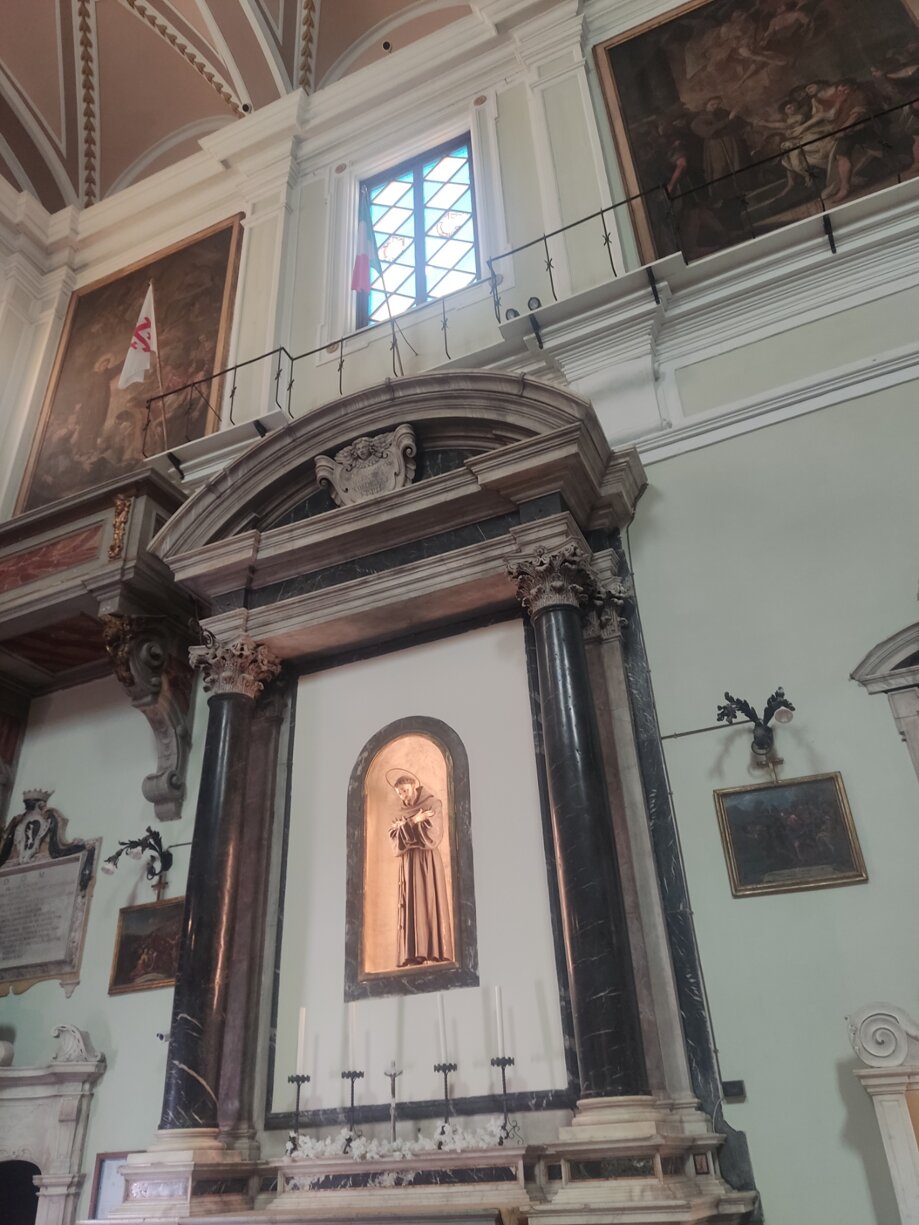
Non si hanno notizie circa l’edificazione di questo altare, probabilmente i lavori iniziarono dopo il
completamento dell’altare Inghirami (1629). Si noti l’altare in marmo bianco, i pilastri in marmo
nero venato di bianco, c’è un particolare, le “paraste” sono di “breccia” che è una roccia
sedimentaria. In quest’altare, a differenza degli altri, si è usato anche il “portoro”, un marmo
policromo assai ricercato a fondo nero con venature giallo-oro. Al centro del timpano leggiamo
l’iscrizione latina: “D. FRANCISCO EREXERE CORDIGERI ET PII”. Fu eretto dalla Confraternita Cordigeri
laica che si ispiravano agli ideali del Santo d’Assisi e da un gruppo di pie persone. Vi era una tela
dipinta da Matteo Rosselli (1578 – 1650) raffigurante San Francesco e Santa Chiara inginocchiati,
che ricevevano dalla Madonna i cordigli, segni della vita consacrata ed anche simboli di castità. Nel
vano di quest’altare troviamo oggi la statua di San Francesco di ignoto autore.
ALTAR OF CORDIGERI
We have no information about the building of this altar, probably the works began after the
completion of the altar Inghirami (1629). Note the altar of white marble, the pillars of black marble
veined with white, the "parastades" are made of "breccia" which is a sedimentary rock. In this altar,
unlike the others, is used the "Portoro", a highly sought polychrome marble, with a black
background with yellow-gold veins. At the center of the tympanum read the Latin inscription: "D.
FRANCISCO EREXERE CORDIGERI ET PII. "It was erected by the secular Confraternity
cordigera which drew on the ideals of the Saint of Assisi, and a group of pious people. There was a
picture painted by Matteo Rosselli (1578 - 1650) depicting San Francesco and Santa Chiara knelt,
who received the girdles by Madonna, signs of religious life as well as symbols of chastity. In this
altar compartment are today the statue of St. Francesco by an unknown author.
ALTAR DE CORDIGERI
No hay noticias sobre la construcción de este altar , probablemente la obra se inició después de la
realización del altar Inghirami ( 1629) . Tenga en cuenta el altar de mármol blanco, las columnas de
mármol negro con vetas blancas , hay un particular, " pilastras " son " avance" , que es una roca
sedimentaria. En este altar , a diferencia de los demás , también se ha utilizado la " portoro " , un
mármol policromado muy solicitado en un fondo negro con vetas de color amarillo- oro. En el
centro del tímpano leer la inscripción en latín : " D. FRANCISCO EREXERE CORDIGERI ET PII
" . Fue erigida por el Cordigeri secular Hermandad que se inspira en los ideales del Santo de Asís y
un grupo de gente piadosa . Hubo un lienzo pintado por Matteo Rosselli (1578 - 1650) que
representa a San Francisco y Santa Clara de rodillas , que recibieron de la Virgen cordigli , los
signos de la vida consagrada y también símbolos de la castidad. En el espacio de este altar se
encuentra hoy la estatua de San Francisco de autor desconocido.
AUTEL DES CORDIGERI
On n’a pas d’information à propos de la date d’édification de cet autel, les travaux ont
probablement commencé après la construction de l’Autel Inghirami (1629). On note l’autel en
marbre blanc, les piliers en marbre noir aux veinures blanches. Le parastade est en brèche, roche
sédimentaire. Dans cet autel, à différence des autres, a été utilisé le « portore », un marbre
polychrome très recherché au fond noir et aux veinures jaune or. Au centre du tympan on lit
l’inscription latine : « D. FRANCISCO EREXERE CORDIGERI ET PII ». Il a été élevé par la
Confrérie Cordigeri laïque qui s’inspirait aux idéaux du Saint d’Assises et d’un groupe de personnes
pieuses. Il s’y trouvait une toile peinte par Matteo Rosselli (1578-1650) qui raffigurait Saint
François et Sainte Claire agenouillés, recevant les cordelières de la Madone, signes de la vie
consacrée et symboles de chasteté. Dans l’embrasure de cet autel on trouve aujourd’hui la statue de
Saint François d’auteur inconnu.
ALTAR OF CORDIGERI
Es gibt keine Nachrichten über den Bau von diesem Altar , wahrscheinlich die Arbeit begann nach
dem Abschluss des Altars Inghirami ( 1629 ) . Notieren Sie sich den Altar aus weißem Marmor , die
Säulen aus schwarzem Marmor mit weißen Adern , gibt es eine besondere " Pilaster " sind "
Durchbruch" , die ein Sedimentgestein ist . In diesem Altar , anders als die anderen , hat auch die "
portoro " , ein gefragter buntem Marmor auf einem schwarzen Hintergrund mit gelb- Gold-Adern
verwendet . In der Mitte des Trommelfells lesen die lateinische Inschrift : " D. FRANCISCO
EREXERE CORDIGERI ET PII . " Es wurde von der Bruderschaft säkularen Cordigeri die von den
Idealen des Heiligen von Assisi und einer Gruppe von frommen Menschen inspiriert wurden
errichtet . Es war ein Gemälde von Matteo Rosselli (1578 - 1650) gemalt zeigt St. Franziskus und
St. Clare kniend , erhielten sie von der Madonna cordigli , Zeichen des geweihten Lebens und auch
Symbole der Keuschheit. Innerhalb von diesem Altar finden wir heute die Statue des Hl. Franziskus
von unbekannten Autor .
OLTÁR CORDIGERI
Nemáme žiadne informácie o stavbe tohto oltára, pravdepodobne práce začala po dokončení oltára
Inghirami (1629). Všimnite si oltár z bieleho mramoru, piliere sú čierneho mramoru s bielymi žily,
zvláštnosťou sú pilastry, ktoré sú vyrobené zo štrku, čo je usadená hornina. Na tomto oltári sa na
rozdiel od iných tiež používal „portoro“, veľmi vyhľadávaný polychrómovaný mramor s čiernym
pozadím a so zlatožltými žilami. V centre tympanonu čítame nápis v latinčine: „D. FRANCISCO
EREXERE CORDILERI ET PII“. Oltár bol postavený Bratstvom Cordileri, laikmi, ktorí boli
inšpirovaní ideálmi svätca z Assisi a skupinou zbožných ľudí. Bolo tam plátno namaľované
Matteom Rosselli (1578-1650), znázorňujúci Svätého Františka a Svätú Claru kľačiacich,
prijímajúcich od panny Marie mníšské opasky, známky náboženského života a tiež symboly čistoty.
V priestore tohto oltára je dnes socha svätého Františka od neznámeho autora.